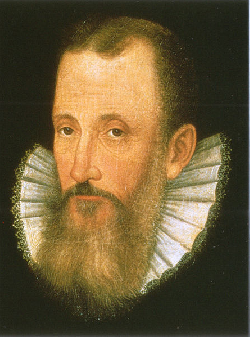
George Talbot, 6th Earl of Shrewsbury
English Earl
- Life
- 1528 - 18 November 1590
- Birthday
- November 18
George Talbot, 6th Earl of Shrewsbury, 6th Earl of Waterford, 12th Baron Talbot, 11th Baron Furnivall, KG, Earl Marshal (1528 – 18 November 1590) was an English magnate and military commander.
Life
Talbot was the only son of Francis Talbot, 5th Earl of Shrewsbury and Mary Dacre. In early life he saw active military service, when he took part in the invasion of Scotland under the Protector Somerset. He was sent by his father in October 1557 to the relief of Thomas Percy, 7th Earl of Northumberland pent up in Alnwick Castle. He then remained for some months in service on the border, with five hundred horsemen under his command.:s:Talbot, George, sixth Earl of Shrewsbury (DNB00)Talbot coat of arms
In 1560, he inherited the Earldom of Shrewsbury, the Barony of Furnivall and the position of Justice in Eyre, which had been his father's. One year later, he was created a Knight of the Garter, and in 1567, he married Bess of Hardwick in a double wedding with their two eldest children from previous marriages.
Shrewsbury was selected as the keeper of Mary, Queen of Scots, who was imprisoned by Queen Elizabeth I in 1568 after she had escaped to England from Scotland following the disastrous Battle of Langside. Elizabeth imposed the responsible task of guarding Mary on him, and did not allow him to resign the charge for around 18 years. For this and other reasons his marriage became rocky.
Shrewsbury received his ward at Tutbury Castle on 2 February 1569, but in June he removed to Wingfield Manor. There a rescue was attempted by Leonard Dacre. The Earl had several houses and castles in the interior of the kingdom, in any of which Mary might be kept with little danger. In September the household was back again at Tutbury, where an additional guard or spy, temporarily joined the family in the person of Henry Hastings, 3rd Earl of Huntingdon. In November took place the Northern Rebellion, with the revolt of the Earls of Northumberland and Westmorland, who planned to march on Tutbury. Mary was for the time being moved to Coventry, and did not return until the following January. In May 1570 Shrewsbury conducted her to Chatsworth, and he foiled another cabal for her release. Cecil and Mildmay visited Chatsworth in October, and agreed on Mary's removal to Sheffield Castle (Shrewsbury's principal seat), which took place shortly afterwards. At Sheffield, apart from occasional visits to the baths at Buxton, to Chatsworth, or to the old Hardwick Hall, she remained under Shrewsbury's guardianship for the next fourteen years. During the winter of 1571-2 the earl was in London, the queen during his absence being left in charge of Sir Ralph Sadler.
Meanwhile, in 1571, Lord Shrewsbury was appointed Lord High Steward (the premier Great Office of State) for the trial of Thomas Howard, 4th Duke of Norfolk (regarding the Ridolfi plot). Finally, in 1572, Lord Shrewsbury was appointed Earl Marshal, a position that he held (along with the aforementioned position of Justice in Eyre) until his death in 1590. He was buried in the Shrewsbury chapel at Sheffield Parish Church (now Sheffield Cathedral), where a large monument to him can still be seen.
Family
By his first wife Gertrude Manners, daughter of Thomas Manners, 1st Earl of Rutland, Shrewsbury had issue:
- Francis, Lord Talbot, who married, in 1562, Anne, daughter of William Herbert, 1st Earl of Pembroke, but died in his father's lifetime;
- Gilbert, Seventh Earl;
- Henry; who had a daughter named Gertrude who married Robert Pierrepont. Gertrude's mother and siblings are unknown.
- Edward, who succeeded Gilbert as Eighth Earl;
and three daughters; of these,
- Catherine (to whom Queen Elizabeth gave many tokens of friendship) married, in 1563, Henry, Lord Herbert (afterwards second Earl of Pembroke);
- Mary married Sir George Savile of Barrowby, Lincolnshire;
- Grace married Henry, son and heir of Sir William Cavendish of Chatsworth.
By his second wife Shrewsbury had no issue.
Notes
|-
|-
|-
Category:1528 births Category:1590 deaths Category:Earls in the Peerage of England Waterford, George Talbot, 6th Earl of Category:Earls Marshal Category:Knights of the Garter Category:Lord High Stewards Category:Lord-Lieutenants of Derbyshire Category:Lord-Lieutenants of Nottinghamshire Category:Lord-Lieutenants of Staffordshire Category:People of the Tudor period George Category:16th-century English people
In fiction
George Talbot is a primary character in the Philippa Gregory historical fiction novel, The Other Queen.
Letters and papers
Many of Shrewsbury's papers found their way in the College of Arms and were re-united with others in the Lambeth Palace library in 1983 as the "Shrewsbury-Talbot papers". This historical resource was first published in 1791 by Edmund Lodge, and all the letters were more recently summarized in calendar form.
- Lodge, Edmund, ed., , 3 vols., London (1791)
- Lodge, Edmund, ed., , 3 vols., Oxford, (1838)
- Bill, E. G. W., ed., Calendar of Shrewsbury papers in the Lambeth Palace Library, Derbyshire Record Society (1966)
- Batho, G. R., ed., Calendar of the Shrewsbury and Talbot manuscripts in the College of Arms, HMC (1971)


