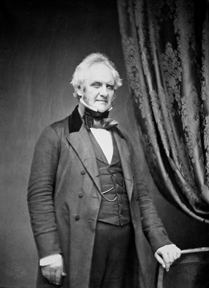
George Peabody
United States philanthropist
- Life
- 18 February 1795 - 04 November 1869
- Birthday
- February 18
- Length
- 2 parts
George Peabody (This is the standard pronunciation in the United States, and presumably how Peabody himself pronounced his name. In Britain, however, the name of George Peabody himself, and of the Peabody Trust, is invariably pronounced as spelt, Pea-body . February 18, 1795 – November 4, 1869) was an American-British entrepreneur and philanthropist who founded the Peabody Trust in Britain and the Peabody Institute and George Peabody Library in Baltimore, and was responsible for many other charitable initiatives.
Business
While serving as a volunteer in the War of 1812, Peabody met Elisha Riggs, who, in 1814, provided financial backing for what became the wholesale dry goods firm of Riggs, Peabody & Co., specializing in importing dry goods from Britain. Branches were opened in New York and Philadelphia in 1822. Riggs retired in 1829, and the firm became Peabody, Riggs & Co., with the names reversed as Peabody became the senior partner.
Peabody first visited the United Kingdom in 1827 to purchase wares, and to negotiate the sale of American cotton in Peabody), Massachusetts. His family had Puritan antecedents in the state, but was poor, and as one of eight children George suffered some deprivations during his upbringing: these factors influenced his later philanthropic tendencies. His birthplace at 205 Washington Street in the City of Peabody is now the George Peabody House Museum, a museum dedicated to preserving his life and legacy. In 1816, he moved to Baltimore, where he would live for the next 20 years. He established his residence and office in the old Henry Fite House, which had briefly served as the meeting site for the Second Continental Congress in 1776–77, and later as a noted tavern and hotel.
Peabody first visited the United Kingdom in 1827 for business reasons, and over the next decade made four more trans-Atlantic trips, establishing a branch office in Liverpool, and later the banking firm of "George Peabody & Company" in London. In 1837, he took up permanent residence in London, remaining there for the rest of his life.
In February 1867, on one of several return visits to the United States, and at the height of his financial success, Peabody's name was suggested by Francis Preston Blair, an old crony of sixth President Andrew Jackson and an active power in the smoldering Democratic Party as a possible Secretary of the Treasury in the cabinet of seventeenth President Andrew Johnson. At about the same time, his name was also mentioned in newspapers as a future presidential candidate. Peabody described the presidential suggestion as a "kind and complimentary reference", but considered that he was too old for either office (age 72).Parker 1995, pp. 164-5, 203, 214.
Although he was briefly engaged in 1838 (and later allegedly had a mistress, who bore him a daughter, in Brighton, England), Peabody however never married.Parker 1995, pp. 29-33. He died in London on November 4, 1869, aged 74, at the house of his friend Sir Curtis Miranda Lampson. At the request of the Dean of Westminster of the Church of England, and with the approval of Queen Victoria, Peabody was given a temporary burial in England's most sacred spot, Westminster Abbey.
His will provided that he be buried in the town of his birth, Danvers, Massachusetts, and Prime Minister William Ewart Gladstone arranged for Peabody's remains to be returned to America on "H.M.S. Monarch", the newest and largest ship in the Royal Navy, arriving at Boston. He was laid to rest in Harmony Grove Cemetery, in Salem, Massachusetts, on February 8, 1870. Peabody's death and the pair of funerals were international news, through the newly-completed trans-Atlantic underwater telegraph cable, with hundreds of people participating in the ceremonies and thousands attending or observing.
Philanthropy
Peabody is the acknowledged father of modern philanthropy, having established the practice later followed by Johns Hopkins, Andrew Carnegie, John D. Rockefeller and Bill Gates. In the United States, his philanthropy largely took the form of educational initiatives. In Britain, it took the form of providing housing for the poor.
Continue reading: part 2 of 2 →


