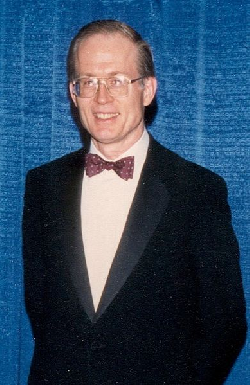
Fischer Black
Economist
- Life
- January 11, 1938 - August 30, 1995
- Birthday
- January 11
- Length
- 2 parts
Fischer Sheffey Black (January 11, 1938 – August 30, 1995) was an American economist, best known as one of the authors of the famous Black–Scholes equation.
Background
Black graduated from Harvard College in 1959 and received a Ph.D. in applied mathematics from Harvard University in 1964. He was initially expelled from the PhD program due to his inability to settle on a thesis topic, having switched from physics to mathematics, then to computers and artificial intelligence. Black joined the consultancy Bolt, Beranek and Newman, working on a system for artificial intelligence. He spent a summer developing his ideas at the RAND corporation. He became a student of MIT professor Marvin Minsky,Perry Mehrling, "Fischer Black and the Revolutionary Idea of Finance", Wiley (2005), 400 pages, ISBN 978-0-471-45732-9 and was later able to submit his research for completion of the Harvard PhD.
Black joined Arthur D. Little, where he was first exposed to economic and financial consulting and where he met his future collaborator Jack Treynor. In 1971, he began to work at the University of Chicago. He later left the University of Chicago to work at the MIT Sloan School of Management. In 1984, he joined Goldman Sachs where he worked until his death.
Economic career
Black began thinking seriously about monetary policy around 1970 and found, at this time, that the big debate in this field was between Keynesians and monetarists. The Keynesians (under the leadership, at that moment, of Franco Modigliani) believe there is a natural tendency of the credit markets toward instability, toward boom and bust, and they assign to both monetary and fiscal policy roles in dampening down this cycle, working toward the goal of smooth sustainable growth. In the Keynesian view, central bankers have to have discretionary powers to fulfill their role properly. Monetarists, under the leadership of Milton Friedman, believe that discretionary central banking is the problem, not the solution. Friedman believed that the growth of the money supply could and should be set at a constant rate, say 3% a year, to accommodate predictable growth in real GDP.
On the basis of the capital asset pricing model, Black concluded that discretionary monetary policy could not do the good that Keynesians wanted it to do. But he also concluded that it could not do the harm monetarists feared it would do. Black said in a letter to Friedman, in January 1972:
In the U.S. economy, much of the public debt is in the form of Treasury bills. Each week, some of these bills mature, and new bills are sold. If the Federal Reserve System tries to inject money into the private sector, the private sector will simply turn around and exchange its money for Treasury bills at the next auction. If the Federal Reserve withdraws money, the private sector will allow some of its Treasury bills to mature without replacing them.
In 1973, Black, along with Myron Scholes, published the paper 'The Pricing of Options and Corporate Liabilities' in 'The Journal of Political Economy'. This was his most famous work and included the Black–Scholes equation.
In March 1976, Black proposed that human capital and business have "ups and downs that are largely unpredictable [...] because of basic uncertainty about what people will want in the future and about what the economy will be able to produce in the future. If future tastes and technology were known, profits and wages would grow smoothly and surely over time." A boom is a period when technology matches well with demand. A bust is a period of mismatch. This view made Black an early contributor to real business cycle theory.
Selected bibliography
- Fischer Black and the Revolutionary Idea of Finance, by Perry Mehrling, published by Wiley, August 2005, ISBN 0-471-45732-9
- Fischer Black, Myron Scholes, & Micheal Jensen, "The Capital-Asset Pricing Model: Some empirical tests", in Jensen, editor, Studies in the Theory of Capital Markets (1972).


