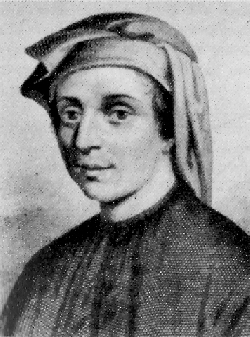
Fibonacci
Italian mathematician and writer
- Life
- c. 1170 - c. 1250
Leonardo Pisano Bigollo (c. 1170 – c. 1250)known as Fibonacci, and also Leonardo of Pisa, Leonardo Pisano, Leonardo Bonacci, Leonardo Fibonacciwas an Italian mathematician, considered by some "the most talented western mathematician of the Middle Ages."Howard Eves. An Introduction to the History of Mathematics. Brooks Cole, 1990: ISBN 0-03-029558-0 (6th ed.), p 261.
Fibonacci is best known to the modern world for. Encyclopædia Britannica Online, 2006. Retrieved 18 September 2006. the spreading of the Hindu–Arabic numeral system in Europe, primarily through his composition in 1202 of Liber Abaci (Book of Calculation), and for a number sequence named the Fibonacci numbers after him, which he did not discover but used as an example in the Liber Abaci.Parmanand Singh. "Acharya Hemachandra and the (so called) Fibonacci Numbers". Math. Ed. Siwan , 20(1):28-30, 1986. ISSN 0047-6269]
Life
Leonardo Fibonacci was born around 1170 to Guglielmo Bonacci, a wealthy Italian merchant. Guglielmo directed a trading post (by some accounts he was the consul for Pisa) in Bugia, a port east of Algiers in the Almohad dynasty's sultanate in North Africa (now Béjaïa, Algeria). As a young boy, Leonardo traveled with him to help; it was there he learned about the Hindu–Arabic numeral system.
Recognizing that arithmetic with Hindu–Arabic numerals is simpler and more efficient than with Roman numerals, Fibonacci travelled throughout the Mediterranean world to study under the leading Arab mathematicians of the time. Leonardo returned from his travels around 1200. In 1202, at the age of 32, he recorded what he had learned in Liber Abaci (Book of Abacus or Book of Calculation), and thereby popularized Hindu–Arabic numerals in Europe.
Leonardo became an amicable guest of the Emperor Frederick II, who enjoyed mathematics and science. In 1240 the Republic of Pisa honored Leonardo, referred to as Leonardo Bigollo,See the incipit of Flos: "Incipit flos Leonardi bigolli pisani..." (quoted in the MS Word document by David Singmaster, 18 March 2004 - emphasis added), in English: "Here starts 'the flower' by Leonardo the wanderer of Pisa..."The basic meanings of "bigollo" appear to be "good-for-nothing" and "traveller" (so it could be translated by "vagrant", "vagabond" or "tramp"). A. F. Horadam contends a connotation of "bigollo" is "absent-minded" (see first footnote of ), which is also one of the connotations of the English word "wandering". The translation "the wanderer" in the quote above tries to combine the various connotations of the word "bigollo" in a single English word. by granting him a salary.
Fibonacci died in Pisa, but the date of his death is unknown, with estimates ranging from 1240. to 1250..
Legacy
In the 19th century, a statue of Fibonacci was constructed and erected in Pisa. Today it is located in the western gallery of the Camposanto, historical cemetery on the Piazza dei Miracoli.
Fibonacci is also a character in the children's book Crusade in Jeans by Thea Beckman.
There are many mathematical concepts named after Fibonacci, for instance because of a connection to the Fibonacci numbers. Examples include the Brahmagupta–Fibonacci identity, the Fibonacci search technique, and the Pisano period. Beyond mathematics, namesakes of Fibonacci include the asteroid 6765 Fibonacci and the art rock band The Fibonaccis.
Liber Abaci
A page of Fibonacci's [[Liber Abaci from the Biblioteca Nazionale di Firenze showing (in box on right) the Fibonacci sequence with the position in the sequence labeled in Roman numerals and the value in Hindu-Arabic numerals.]]
In the Liber Abaci (1202), Fibonacci introduces the so-called modus Indorum (method of the Indians), today known as Arabic numerals (Sigler 2003; Grimm 1973). The book advocated numeration with the digits 0–9 and place value. The book showed the practical importance of the new numeral system by applying it to commercial bookkeeping, conversion of weights and measures, the calculation of interest, money-changing, and other applications. The book was well received throughout educated Europe and had a profound impact on European thought.
Notes
Works
- Liber Abaci (1202), a book on calculations (English translation by Laurence Sigler, Springer, 2002)
- Practica Geometriae (1220), a compendium of techniques in surveying, the measurement and partition of areas and volumes, and other topics in practical geometry (English translation by Barnabas Hughes, Springer, 2008).
- Flos (1225), solutions to problems posed by Johannes of Palermo
- Liber quadratorum ("The Book of Squares"), on Diophantine equations, dedicated to Emperor Frederick II. See in particular the Brahmagupta–Fibonacci identity.
- Di minor guisa (on commercial arithmetic; lost)
- Commentary on Book X of Euclid's Elements (lost)
19th century statue of Fibonacci in Camposanto, Pisa.
Fibonacci sequence
Liber Abaci also posed, and solved, a problem involving the growth of a population of rabbits based on idealized assumptions. The solution, generation by generation, was a sequence of numbers later known as Fibonacci numbers. The number sequence was known to Indian mathematicians as early as the 6th century,Rachel W. Hall. . Math Horizons 15 (2008) 10-11. but it was Fibonacci's Liber Abaci that introduced it to the West.
In the Fibonacci sequence of numbers, each number is the sum of the previous two numbers. Fibonacci began the sequence not with 0, 1, 1, 2, as modern mathematicians do but with 1, 2, etc. He carried the calculation up to the twelfth place (fourteenth in modern counting), that is 233, though another manuscript carries it to the next place: 1, 2, 3, 5, 8, 13, 21, 34, 55, 89, 144, 233, 377. from . Fibonacci did not speak about the golden ratio as the limit of the ratio of consecutive numbers in this sequence.