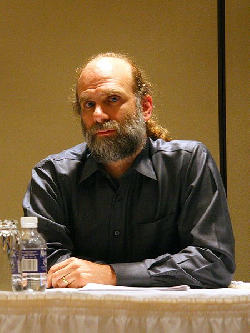
Bruce Schneier Part 2
American computer scientist
- Life
- January 15, 1963
- Birthday
- January 15
- Length
- 2 parts
Viewpoints
Cryptography
To Schneier, peer review and expert analysis are important for the security of cryptographic systems. Mathematical cryptography is usually not the weakest link in a security chain; effective security requires that cryptography be combined with other things.
The term Schneier's law was coined by Cory Doctorow in his speech about Digital Rights Management for Microsoft Research, which is included in his 2008 book Content: Selected Essays on Technology, Creativity, Copyright, and the Future of the Future. The law is phrased as:
He attributes this to Bruce Schneier, presumably making reference to his book Applied Cryptography, although the principle predates its publication. In The Codebreakers, David Kahn states:
DRM
Schneier is critical of digital rights management (DRM) and has said that it allows a vendor to increase "lock in." Proper implementation of control-based security for the user via trusted computing is very difficult, and security is not the same thing as control.
Homeland security
Schneier has said that homeland security money should be spent on intelligence, investigation, and emergency response. Defending against the broad threat of terrorism is generally better than focusing on specific potential terrorist plots. According to Schneier, analysis of intelligence data is difficult but is one of the better ways to deal with global terrorism. Human intelligence has advantages over automated and computerized analysis, and increasing the amount of intelligence data that is gathered does not help to improve the analysis process. Agencies that were designed around fighting the Cold War may have a culture that inhibits the sharing of information; the practice of sharing information is more important and less of a security threat in itself when dealing with more decentralized and poorly funded adversaries such as al Qaeda.
Regarding PETN- the explosive that has become the terrorists’ weapon of choice- Schneier has written that only swabs and dogs can detect it. He also believes that changes to airport security since 11 September 2001 have done more harm than good and defeated former head of the Transportation Security Administration, Kip Hawley, in an Economist online debate by 87% to 13% regarding the issue."International terrorism: AQAP tries again: Good intelligence work still leaves questions over airport security", The Economist, dated 12 May 2012.
System design
Schneier has criticized security approaches that try to prevent any malicious incursion, instead arguing that designing systems to fail well is more important., Atlantic Monthly, September 2002 The designer of a system should not underestimate the capabilities of an attacker; technology may make it possible in the future to do things that are not possible at the present. Under Kerckhoffs's Principle, the need for one or more parts of a cryptographic system to remain secret increases the fragility of the system; whether details about a system should be obscured depends upon the availability of persons who can make use of the information for beneficial uses versus the potential for attackers to misuse the information.
"Secrecy and security aren't the same, even though it may seem that way. Only bad security relies on secrecy; good security works even if all the details of it are public."Doctorow, Cory. Little Brother. New York: Tor Teen, 2008, page 129.Full disclosure
Schneier is a proponent of full disclosure, i.e. making security issues public.
"If researchers don’t go public, things don’t get fixed. Companies don't see it as a security problem; they see it as a PR problem." Huffinton Post, 2011.Early life
Bruce Schneier is a son of Martin Schneier, a Brooklyn Supreme Court judge. He grew up in Flatbush, attending P.S. 139 and Hunter High School. After receiving a physics bachelor's degree from the University of Rochester in 1984, he went to the American University in Washington, D.C. and got his master's degree in computer science in 1988.Charles C. Mann www.theatlantic.com He was awarded an honorary Ph.D from the University of Westminster in London, England in November 2011. The award was made by the Department of Electronics and Computer Science in recognition of Schneier's 'hard work and contribution to industry and public life'.
Schneier is the founder and chief technology officer of BT Managed Security Solutions, formerly Counterpane Internet Security, Inc.
Cryptographic algorithms
Schneier has been involved in the creation of many cryptographic algorithms.
Hash functions:
- Skein
Stream ciphers:
- Solitaire
- Phelix
- Helix
Pseudo-random number generators:
- Fortuna
- Yarrow algorithm
Block ciphers:
- Twofish
- Blowfish
- Threefish
- MacGuffin
Activism
Bruce Schneier is a board member of the Electronic Frontier Foundation.
Other writing
Schneier and Karen Cooper were nominated in 2000 for the Hugo Award, in the category of Best Related Book, for their Minicon 34 Restaurant Guide, a work originally published for the Minneapolis science fiction convention Minicon which gained a readership internationally in science fiction fandom for its wit and good humor.

