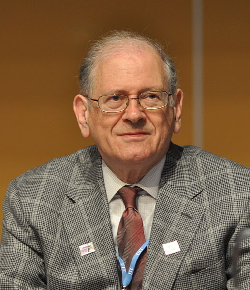
Bob Kahn
American computer scientist
- Life
- December 23, 1938
- Birthday
- December 23
- Length
- 2 parts
Robert Elliot "Bob" Kahn (born December 23, 1938) is an American Internet pioneer, engineer and computer scientist, who, along with Vint Cerf, invented the Transmission Control Protocol (TCP) and the Internet Protocol (IP), the fundamental communication protocols at the heart of the Internet.
The Internet
While working on a satellite packet network project, he came up with the initial ideas for what later became the Transmission Control Protocol (TCP), which was intended as a replacement for an earlier network protocol, NCP, used in the ARPANET. While working on this, he played a major role in forming the basis of open-architecture networking, which would allow computers and networks all over the world to communicate with each other, regardless of what hardware or software the computers on each network used. To reach this goal, TCP was designed to have the following features:
- Small sub-sections of the whole network would be able to talk to each other through a specialized computer that only forwarded packets (first called a gateway, and now called a router).
- No portion of the network would be the single point of failure, or would be able to control the whole network.
- Each piece of information sent through the network would be given a sequence number, to ensure that they were dealt with in the right order at the destination computer, and to detect the loss of any of them.
- A computer which sent information to another computer would know that it was successfully received when the destination computer sent back a special packet, called an acknowledgement (ACK), for that particular piece of information.
- If information sent from one computer to another was lost, the information would be retransmitted, after the loss was detected by a timeout, which would recognize that the expected acknowledgement had not been received.
- Each piece of information sent through the network would be accompanied by a checksum, calculated by the original sender, and checked by the ultimate receiver, to ensure that it was not damaged in any way en route.
Vint Cerf joined him on the project in the spring of 1973, and together they completed an early version of TCP. Later, it was separated into two separate layers, with the more basic functions being moved to the Internet Protocol (IP). The two together are usually referred to as TCP/IP, and are the basis for the modern Internet.
In 1992 he co-founded with Vint Cerf the Internet Society, to provide leadership in Internet related standards, education, and policy.
Articles
- Vint Cerf & Bob Kahn, Al Gore and the Internet, 2000-09-28
Honorary degrees
Kahn has received honorary degrees from Princeton University, University of Pavia, ETH Zurich, University of Maryland, George Mason University, the University of Central Florida and the University of Pisa, and an honorary fellowship from University College, London.
In 2012 he was also recognized as honorary doctor of Saint Petersburg National Research University of Information Technologies, Mechanics and Optics.
Background information
Kahn was born in Brooklyn, New York City, to Jewish parents (Beatrice Pauline (née Tashker) and Lawrence Kahn, a high school administrator).http://www.nytimes.com/1999/04/30/classified/paid-notice-deaths-kahn-lawrence.html Through his father, he is related to futurist Herman Kahn. After receiving a B.E.E. degree in electrical engineering from the City College of New York in 1960, Kahn earned M.A. and Ph.D. degrees from Princeton University in 1962 and 1964 respectively. After finishing graduate school, he worked for AT&T Bell Laboratories, and then became an assistant professor at MIT. He then worked at Bolt, Beranek and Newman (BBN), where he helped develop the IMP.
In 1972, he began work at the Information Processing Techniques Office (IPTO) within ARPA. In the fall of 1972, he demonstrated the ARPANET by connecting 20 different computers at the International Computer Communication Conference, "the watershed event that made people suddenly realize that packet switching was a real technology." He then helped develop the TCP/IP protocols for connecting diverse computer networks. After he became Director of IPTO, he started the United States government's billion dollar Strategic Computing Initiative, the largest computer research and development program ever undertaken by the U.S. federal government.
Continue reading: part 2 of 2 →

