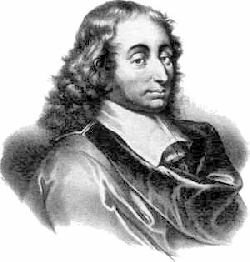
Blaise Pascal Part 2
French mathematician, physicist, philosopher
- Life
- 19 June 1623 - 19 August 1662
- Birthday
- June 19
- Length
- 7 parts
In France, prestigious annual awards, Blaise Pascal Chairs are given to outstanding international scientists to conduct their research in the Ile de France region. One of the Universities of Clermont-Ferrand, France – Université Blaise Pascal – is named after him. The University of Waterloo, Ontario, Canada, holds an annual math contest named in his honour.
Roberto Rossellini directed a filmed biopic (entitled Blaise Pascal) which originally aired on Italian television in 1971. Pascal was a subject of the first edition of the 1984 BBC Two documentary, Sea of Faith, presented by Don Cupitt.
Contributions to mathematics
Pascal continued to influence mathematics throughout his life. His Traité du triangle arithmétique ("Treatise on the Arithmetical Triangle") of 1653 described a convenient tabular presentation for binomial coefficients, now called Pascal's triangle. The triangle can also be represented:
| 0 | 1 | 2 | 3 | 4 | 5 | 6 | |
|---|---|---|---|---|---|---|---|
| 0 | 1 | 1 | 1 | 1 | 1 | 1 | 1 |
| 1 | 1 | 2 | 3 | 4 | 5 | 6 | |
| 2 | 1 | 3 | 6 | 10 | 15 | ||
| 3 | 1 | 4 | 10 | 20 | |||
| 4 | 1 | 5 | 15 | ||||
| 5 | 1 | 6 | |||||
| 6 | 1 |
In 1654, prompted by a friend interested in gambling problems, he corresponded with Fermat on the subject, and from that collaboration was born the mathematical theory of probabilities. The friend was the Chevalier de Méré, and the specific problem was that of two players who want to finish a game early and, given the current circumstances of the game, want to divide the stakes fairly, based on the chance each has of winning the game from that point. From this discussion, the notion of expected value was introduced. Pascal later (in the Pensées) used a probabilistic argument, Pascal's Wager, to justify belief in God and a virtuous life. The work done by Fermat and Pascal into the calculus of probabilities laid important groundwork for Leibniz' formulation of the infinitesimal calculus.
After a religious experience in 1654, Pascal mostly gave up work in mathematics.
Philosophy of mathematics
Pascal's major contribution to the philosophy of mathematics came with his De l'Esprit géométrique ("Of the Geometrical Spirit"), originally written as a preface to a geometry textbook for one of the famous "Petites-Ecoles de Port-Royal" ("Little Schools of Port-Royal"). The work was unpublished until over a century after his death. Here, Pascal looked into the issue of discovering truths, arguing that the ideal of such a method would be to found all propositions on already established truths. At the same time, however, he claimed this was impossible because such established truths would require other truths to back them up—first principles, therefore, cannot be reached. Based on this, Pascal argued that the procedure used in geometry was as perfect as possible, with certain principles assumed and other propositions developed from them. Nevertheless, there was no way to know the assumed principles to be true.
Pascal also used De l'Esprit géométrique to develop a theory of definition. He distinguished between definitions which are conventional labels defined by the writer and definitions which are within the language and understood by everyone because they naturally designate their referent. The second type would be characteristic of the philosophy of essentialism. Pascal claimed that only definitions of the first type were important to science and mathematics, arguing that those fields should adopt the philosophy of formalism as formulated by Descartes.
Continue reading: part 3 of 7 →


