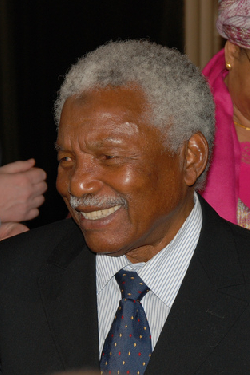
Ali Hassan Mwinyi
Tanzanian President
- Life
- May 8, 1925
- Birthday
- May 8
Ali Hassan Mwinyi (born May 8, 1925, Kivure, Pwani Region, Tanzania) is a Tanzanian politician.
He was the second President of the United Republic of Tanzania from 1985 to 1995. Previous posts include Interior Minister and Vice President. He also was chairman of the ruling party, the Chama Cha Mapinduzi (CCM) from 1990 to 1996.Legacy
Eponyms
- Ali Hassan Mwinyi Road, one of the major roads in Dar es Salaam
- Ali Hassan Mwinyi Stadium, Tabora
- Schools:
- Ali Hassan Mwinyi Islamic Seconday School in Tabora Region
- Mwinyi Secondary School in Pwani Region
Honours and awards
Honours
- Order of Mwalimu Julius Kambarage Nyerere, December 2011
Honorary degrees
- The Open University of Tanzania, Doctor of Letters (Honoris Causa), 2012
- The East African University, Honorary PhD in Business Management, 2013
Personal life
Mwinyi married Siti in 1960 and has six sons and six daughters. In retirement, Mwinyi has stayed out of the limelight and continues to live in Dar es Salaam.
Presidency
During Mwinyi's terms Tanzania took the first steps to reverse the socialist policies of Julius Nyerere.
He relaxed import restrictions and encouraged private enterprise. It was during his second term that multi-party politics were introduced under pressure from foreign donors. Often referred to as Mzee Rukhsa ("Everything goes"), he pushed for liberalization of morals, beliefs, values (without breaking the law) and the economy. He repeated these beliefs while addressing the country against fanatics who burned down pork butcheries; these were fanatics who claimed that eating pork contradicted their respective beliefs. He insisted that Tanzania was a free country and that individual freedom of beliefs was important. Many argue that during Mwinyi's tenure the country was in transition from the failed socialism orientation that brought its economy to its knees. It is during Mwinyi's administration that Tanzania made some of the crucial decisions towards the liberalization of its economy and paved way for short-term economic growth .

